

Need Painting in a Care or Education Space?
Clinics, dental operatories, and classrooms are the hardest rooms in North York to repaint, because they are the rooms that cannot close. A chair sitting idle for a week is lost revenue, and a classroom cannot go dark mid-term. The job gets planned backwards from the schedule, not from the paint.
The buildings make it harder. North York filled in during the postwar boom, and the schools and first-generation professional buildings still standing here are that old. Across the Toronto District School Board the average building is past sixty years, and roughly half the board's schools are over sixty. Behind that age you find plaster over block, painted masonry in the gyms and stairwells, hollow metal frames on their sixth coat, and paint older than 1976, the year Canada first capped lead in interior coatings.
The medical stock has its own pattern. North York General has been at Leslie and Sheppard since 1968 and Baycrest sits at 3560 Bathurst, and around anchors like those you get second-floor professional suites, walk-in clinics in the plazas along Sheppard, Finch and Wilson, and dental offices in strip malls on the arterials. Small suites, tight corridors, and a landlord's rules on top of your own.
None of that changes the colour. It changes the product, the dust control, the room order, and the crew's hours.
What Medical and School Painting Takes
The colour is the easy part. In a care building the job gets judged on dust, on smell, and on whether the room came back into service the day you said it would.
Health care renovation in Canada runs to CSA Z317.13, the standard for infection control during construction, renovation, and maintenance of health care facilities. The facility runs an infection control risk assessment first, and painting lands in it on one word: sanding. Painting with no sanding is a Type A activity, the lowest impact band. Sanding walls to prep them moves the same job to Type C, the moderate-dust band. Pair that with the risk group next door and you get the precaution class, from a Class I cleanup up to Class III and IV: sealed barriers, HEPA filtration, negative pressure, and a sign-off before the hoarding comes down.
Most clinic and school repaints belong at the low end, and our prep keeps them there. Fill and skim early so the sanding is finished before the finish coats. Sand damp, or under a HEPA-shrouded sander. Seal the return-air grille so nothing travels the duct into the next suite.
Lead decides the rest of the method. Ontario's Ministry of Labour guideline classifies the work, not the building. Rolling a lead-containing coating is a Type 1 operation. Scraping or sanding it with hand tools is Type 2a. Power-tool removal without HEPA collection jumps to Type 3a, and abrasive blasting is Type 3b. In a 1960s school that means we encapsulate where the coating is sound and wet-sand where it is not.
Corridors are the one place the code has an opinion about the finish itself, since interior finish there has to hold a flame-spread rating of 25 or better over ninety percent of the exposed surface. A repaint on drywall rarely touches that, but ask before anyone specs a wall covering in an exit corridor. The rest is what any older building hands you: ceiling stains blocked with a stain-killing primer, cracked plaster over door heads, and anchor holes that read from across a waiting room. Office and retail work sits under Painting North York, and our coverage runs the district, including the professional blocks around Don Mills.
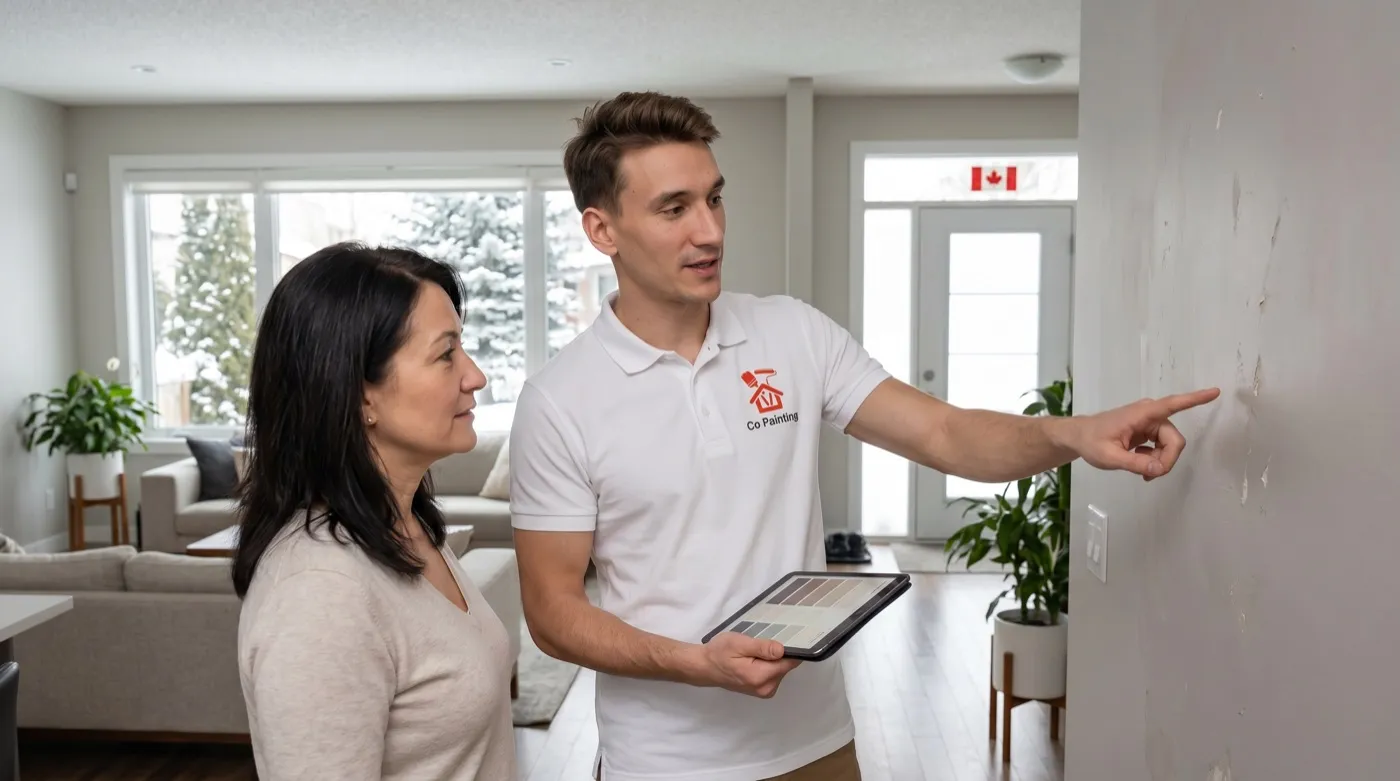
Working Around Chairs, Patients, and the School Calendar
Every one of these buildings runs on a clock, and it is not ours.
Dental practices go operatory by operatory, one or two rooms at a time while the rest of the chairs keep working. Cure time is why. Paint is dry to the touch in hours and still curing weeks later, and Ontario dental offices wipe clinical surfaces with Health Canada registered disinfectants every day they are open. A quaternary ammonium or peroxide wipe on a film that went on last night will burnish it, so treatment rooms go in at the front of a closed stretch.
Medical and specialist suites are usually evenings, weekends, and stat holidays. Reception and the waiting room is often a single Saturday, with the furniture back and no smell left by Monday morning.
Schools publish their calendar, so the dates are never a mystery. In the Toronto District School Board's 2026 to 2027 year, classes start 8 September 2026 and the March break runs 15 to 19 March 2027, with the long window opening at the end of June. Corridors, stairwells, and gyms belong in the summer. A classroom or main office fits March break. Daycare rooms are tighter, since they run through most of those breaks.
Paperwork is part of the schedule. Facilities want a certificate of insurance before a contractor is on site, often a WSIB clearance certificate with it. We are fully insured and licensed in Ontario, and it goes over before the dates are locked. Same routine at a clinic in East York or a school in Parkwoods.
Medical, Dental, and School Services
Clinics and medical offices
Exam rooms, treatment rooms, reception, and the corridors between them, painted off-hours with the return-air grille sealed. Walls go in zero-VOC acrylic latex, and anything wiped daily goes in a scrubbable eggshell instead of the flat the builder left behind.
Dental practices and operatories
Phased one or two chairs at a time so the practice keeps billing. We cut in tight around the chair mount, delivery unit, light arm, and cabinetry, and you get the list of which chairs are down on which nights.
Schools, gyms, and corridors
The big square footage goes in the summer window. Corridor block, stairwells, gym walls, and change rooms. Open masonry gets a block filler first, because rolling finish paint onto hungry block is how a gym wall goes patchy by October.
Daycares and early learning rooms
The tightest schedule of the lot, since childcare rooms stay open through most school breaks. We work closed stretches, weekends, and the holiday shutdown, in zero-VOC product with the odour gone before the room reopens.
Washable and scrubbable wall systems
Cleaning protocols kill flat paint. Corridors, treatment rooms, and washrooms get a scrub-rated finish that survives repeated wiping instead of polishing into shiny patches around the light switch. The institutional zero-VOC lines carry GREENGUARD Gold certification, and that is what we spec to.
Doors, frames, and trim in enamel
Hollow metal frames and solid doors take more abuse than any wall in the building. Carts, gurneys, backpacks, and door stops that quit years ago. They get filled, sanded, and finished in a waterborne enamel that hardens and wipes clean.
Colour for a care or learning room
Calm and neutral in treatment areas, with the accent saved for reception or a wayfinding wall. If you have brand colours or a board standard, we match to it. On a partial repaint we match the existing trim.
Why choose us
Why North York Clinics and Schools Choose Us
We can tell what is behind a 1960s wall
Plaster over block, painted masonry, hollow metal frames on their sixth coat, and coatings older than Canada's 1976 lead limit. We treat lead as a given at that age and pick the low-exposure method up front.
Zero-VOC spec, not just a low-odour promise
Occupied care and learning rooms get zero-VOC product from the institutional lines carrying GREENGUARD Gold certification. Less smell means the room reopens on schedule instead of airing out for two days while your patients wait.
Containment your infection control lead can sign off on
Sealed return-air grille, HEPA scrubber, tacky mat at the door, HEPA vacuum, and prep planned to keep the work in the lowest activity band. We clean down every night and walk the space with your staff before it reopens.
Fifteen years on the tools, backed for three
Our crews average fifteen years of painting and we are rated 5.0 across 70 Google reviews. Fully insured and licensed in Ontario, certificate on request, and three years of workmanship warranty behind the finish.
Nine Things Worth Knowing Before Painting a Clinic or School
- Ask about the risk assessment before you ask about the price. A painter who cannot say what activity type the work falls under has not planned it yet.
- Sanding is the dividing line. Painting with no sanding sits in the lowest activity band. Sanding walls to prep them pushes the same job up one.
- Zero-VOC and low-odour are different claims. VOC content is measurable, odour is not. Ask for both, and for GREENGUARD Gold certification.
- Flat paint has no business in a clinical corridor. It gives up under daily disinfecting and burnishes wherever a hand or a cart lands.
- Cure time is not dry time. A strong disinfectant on a two-day-old film will mark it, so plan the first deep clean around the paint.
- Seal the return-air grille before anyone opens a can. The duct is the fastest route into the suite next door, and masking it takes two minutes.
- Assume lead in anything coated before 1976. It is only a hazard if someone dry-sands it, so the fix is method: encapsulate, wet-sand, HEPA-vac.
- Book school work against the calendar, not the season. Corridors and gyms need the summer. A classroom fits March break. Daycares need a holiday shutdown.
- Get the certificate of insurance into the file before the dates are locked. Facilities will hold a contractor at the door over paperwork.
FAQ
Medical, Dental, and School Questions, Answered
Is the paint safe to use in a clinic that stays open?
Yes, when the product and the containment are right. Zero-VOC, low-odour product, the return-air grille sealed, a HEPA scrubber in the work zone, and most of the work after hours.
Can you paint dental operatories without closing the practice?
Yes. We phase one or two chairs at a time so the rest keep running, starting after the last patient is out, and cut in tight around the chair mount, delivery unit, light arm, and cabinetry.
Do you paint schools and daycares, and when?
Yes. Corridors, stairwells, gyms, and change rooms go in the summer window. A classroom or main office fits March break. Daycare rooms usually go on a holiday shutdown, since they run through most school breaks.
How do you keep dust out of the rest of the building?
Filling and skimming happen early, so the sanding is finished before the finish coats. We sand damp or under a HEPA-shrouded sander, mask the return-air grille, run a HEPA scrubber, and vacuum with a HEPA unit. Where the facility calls for hoarding and negative pressure, we build to that.
Our building went up in the 1960s. Do we have a lead problem?
Assume lead is in the lower layers. Canada did not cap lead in interior paint until 1976, and plenty of North York institutional stock predates that. It is a hazard only if someone sands it dry.
What finish stands up to daily disinfecting?
Not flat. A flat film polishes into shiny patches wherever it is wiped and gives up under repeated cleaning. Corridors, treatment rooms, and washrooms get a scrub-rated eggshell or satin, and doors get a waterborne enamel.
How soon can we wipe the walls down after you paint?
Light dusting is fine within a couple of days. Hold off on hard scrubbing and strong disinfectants for two to four weeks while the film cures. We flag which rooms are still in that window at handover.
Are you insured, and can you send a certificate to our facility manager?
Yes. We are fully insured and licensed in Ontario, and the certificate goes over before the dates are locked. If your board also needs a WSIB clearance certificate, ask at the walkthrough.
How long does a waiting room take, and how do we get a price?
Reception and a waiting room is usually one to two nights including patching, longer with ceiling stains or real drywall repair. Call or send the form and we tour after hours. The scope, sequence, and number come in writing first.